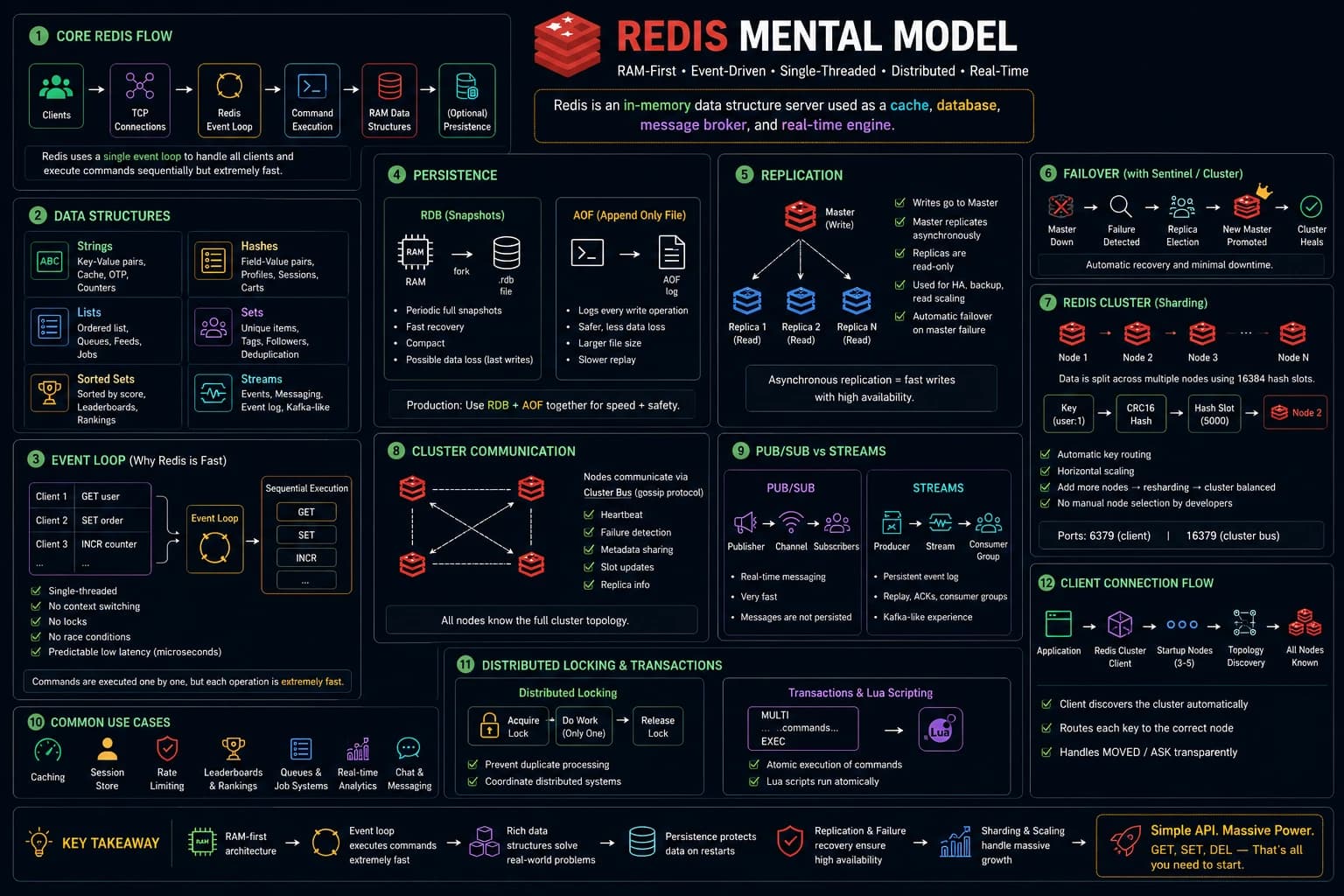
🎯 Big picture of how Redis actually works internally and scales in production systems.
The One Thing That Makes Redis Different
Most databases are:
Disk First
Redis is:
RAM First
That single design decision changes everything.
Because Redis stores data directly in memory:
- reads become insanely fast
- writes become insanely fast
- latency becomes microseconds
- real-time systems become possible
That is why:
- gaming systems
- trading platforms
- chat systems
- food delivery apps
- notification systems
heavily use Redis.
The Core Redis Flow
Redis internally looks like this:
Clients
   ↓
TCP Connections
   ↓
Redis Event Loop
   ↓
Command Execution
   ↓
RAM Data Structures
   ↓
(Optional Persistence)
Every Redis concept builds on this flow.
The Event Loop — The Heart of Redis
This is the part that confuses most beginners.
People hear:
"Redis is single threaded"
and imagine Redis is slow.
Actually Redis is fast BECAUSE of this.
Traditional Servers
Traditional servers often work like:
1 request
↓
1 thread
More users:
- more threads
- more locks
- more context switching
- more synchronization overhead
Eventually CPU wastes time managing threads.
Redis Takes Opposite Approach
Redis uses:
One main event loop
that continuously handles:
- connections
- reads
- writes
- command scheduling
Commands execute:
- sequentially
- one-by-one
- extremely fast
Example:
Client1 → GET user
Client2 → SET order
Client3 → INCR counter
Redis processes:
GET
SET
INCR
one at a time.
Then Why Is Redis Still So Fast?
Because Redis operations are tiny.
Most operations:
- hash lookups
- memory reads
- counter increments
take:
microseconds
not milliseconds.
Redis avoids:
- locks
- thread fights
- race conditions
- synchronization delays
So even sequential execution becomes extremely fast.
That is the Redis superpower.
Redis Is Actually a Data Structure Engine
Most people think Redis is:
just cache
Wrong.
Redis is really:
A Data Structure Server
Strings
Used for:
- cache
- OTP
- counters
Hashes
Used for:
- profiles
- session objects
- carts
Lists
Used for:
- queues
- feeds
- job systems
Sets
Used for:
- unique values
- tags
- followers
Sorted Sets
One of Redis's most powerful structures.
Used for:
- leaderboards
- rankings
- priority systems
Streams
Redis Streams transformed Redis from:
cache
into:
event streaming system
Very similar to lightweight Kafka.
But RAM Has One Huge Problem
RAM is volatile.
Machine restart:
everything disappears
So Redis needed persistence.
Redis Persistence
Redis solves this in two ways.
RDB Snapshots
Redis periodically creates full snapshots.
Mental model:
RAM
 ↓
Fork Child Process
 ↓
Generate Snapshot
 ↓
Save .rdb File
Fast. Compact. Good recovery.
But latest writes may be lost.
AOF (Append Only File)
Instead of snapshots:
Redis logs every write command.
SET user John
INCR views
DEL cache
Now Redis can replay operations during restart.
Safer. But larger and slower.
Production Systems Usually Use Both
Because:
- RDB gives fast recovery
- AOF gives durability
Eventually One Redis Server Stops Being Enough
Single Redis node eventually hits limits:
RAM full
CPU saturated
network saturated
Now Redis must scale horizontally.
This is where Redis Cluster begins.
Redis Cluster Changes Everything
Instead of:
One giant Redis
we now have:
Many Redis nodes
working together.
Example:
Node1
Node2
Node3
Node4
Node5
Each node stores:
partial data
This is called:
Sharding
Redis Sharding Model
Redis Cluster internally creates:
16384 hash slots
Every key belongs to one slot.
Flow:
Key
 ↓
CRC16 Hash
 ↓
Hash Slot
 ↓
Correct Redis Node
Example:
user:1
 ↓
slot 5000
 ↓
Node2
Important Thing
Application developers NEVER manually choose nodes.
Redis client handles:
- hashing
- routing
- topology discovery
automatically.
Your code still looks simple:
GET
SET
DEL
even though internally:
20 Redis servers
may exist.
Redis Nodes Must Communicate Too
Clustered Redis nodes constantly exchange metadata.
For this Redis uses:
Cluster Bus
Usually:
6379  → client traffic
16379 → cluster communication
Nodes continuously gossip:
- who is alive
- who failed
- slot ownership
- replica info
This is called:
Gossip Protocol
Every node gradually learns full cluster topology.
Replication Makes Redis Highly Available
Sharding alone is not enough.
If one node dies:
data gone
So Redis adds replicas.
Example:
Master1 → Replica1
Master2 → Replica2
Master3 → Replica3
Writes go to:
masters
Replicas continuously copy updates.
What Happens During Failure?
Suppose:
Master2 dies
Other nodes detect failure using:
heartbeat timeout
Replica election starts.
Replica promoted automatically.
Now cluster heals itself.
This is why Redis feels highly available.
Scaling Redis Cluster
As traffic grows:
add more Redis nodes
Redis automatically:
- redistributes slots
- migrates keys
- updates topology
without shutting down cluster.
This process is called:
Resharding
Redis Is Not Only Cache Anymore
Modern Redis powers:
- chat systems
- websocket state
- leaderboards
- event systems
- queues
- gaming
- real-time analytics
Redis became:
real-time infrastructure layer
for modern applications.
Pub/Sub vs Streams
Redis supports two messaging models.
Pub/Sub
Publisher
   ↓
Channel
   ↓
Subscribers
Fast. Realtime. But messages disappear if subscriber offline.
Streams
Persistent event log.
Supports:
- replay
- ACKs
- consumer groups
Much closer to Kafka architecture.
Final Redis Mental Model
Redis internally is:
RAM-first
event-driven
single-threaded execution
distributed
real-time optimized
And Redis scales using:
Sharding
+
Replication
+
Cluster Gossip
+
Automatic Failover
+
Event Loop Architecture
while keeping application code extremely simple.
That simplicity is why Redis became one of the most important backend infrastructure tools in modern engineering.